
News

Habibi in the Apple "Behind the Mac" campaign
There are moments that don't announce themselves with much fanfare, and for that very reason, they stick in your mind. For us, the inquiry from Apple was precisely one of those moments. Not because everything suddenly changed. But because it showed us in a very direct way that our work is seen even outside of our own world. In 2021, Apple launched a German version of "Behind the Mac" for the first time. The campaign brought together 23 creatives from various fields — music, design, illustration, acting, fashion, photography, street art, directing, media, and development. We were part of this lineup. For us, it wasn't a classic "Habibi moment" in the sense of our own campaign. It was something different: the experience of appearing in a larger creative context and being effortlessly present there. Perhaps that's precisely what made it so special. That it wasn't just about us, but about a selection of people and projects that represented different forms of contemporary living, design, and creative work. Apple ran the campaign in Germany on its own website and through moving images; in the reports, it is described as the German edition of the well-known "Behind the Mac" series, which had previously run primarily in the US and Great Britain. For us, however, this context gained a second dimension when it spilled out of the screen and into the urban space. Suddenly, we appeared on a giant billboard at the Hamburg Docks, as well as in subway stations and at other locations in the city. Such moments have something surreal about them — especially when, as a young brand, you usually work primarily from your own energy, from ideas, designs, small decisions, long nights, and the will to build something of your own. That's precisely why this experience is still so present for us today. Not because it was loud. But because it quietly confirmed to us that creative work can take paths that you can't fully plan yourself. That a brand like Habibi, which emerged from a very unique attitude, suddenly becomes visible in an environment larger than its own radius. In retrospect, for us, it was less an advertising moment than a moment of recognition. One of those rare moments when you briefly pause and realize that what you have built not only has internal significance but is also perceived externally.
Learn more
Mom, Dad - we're at the museum!
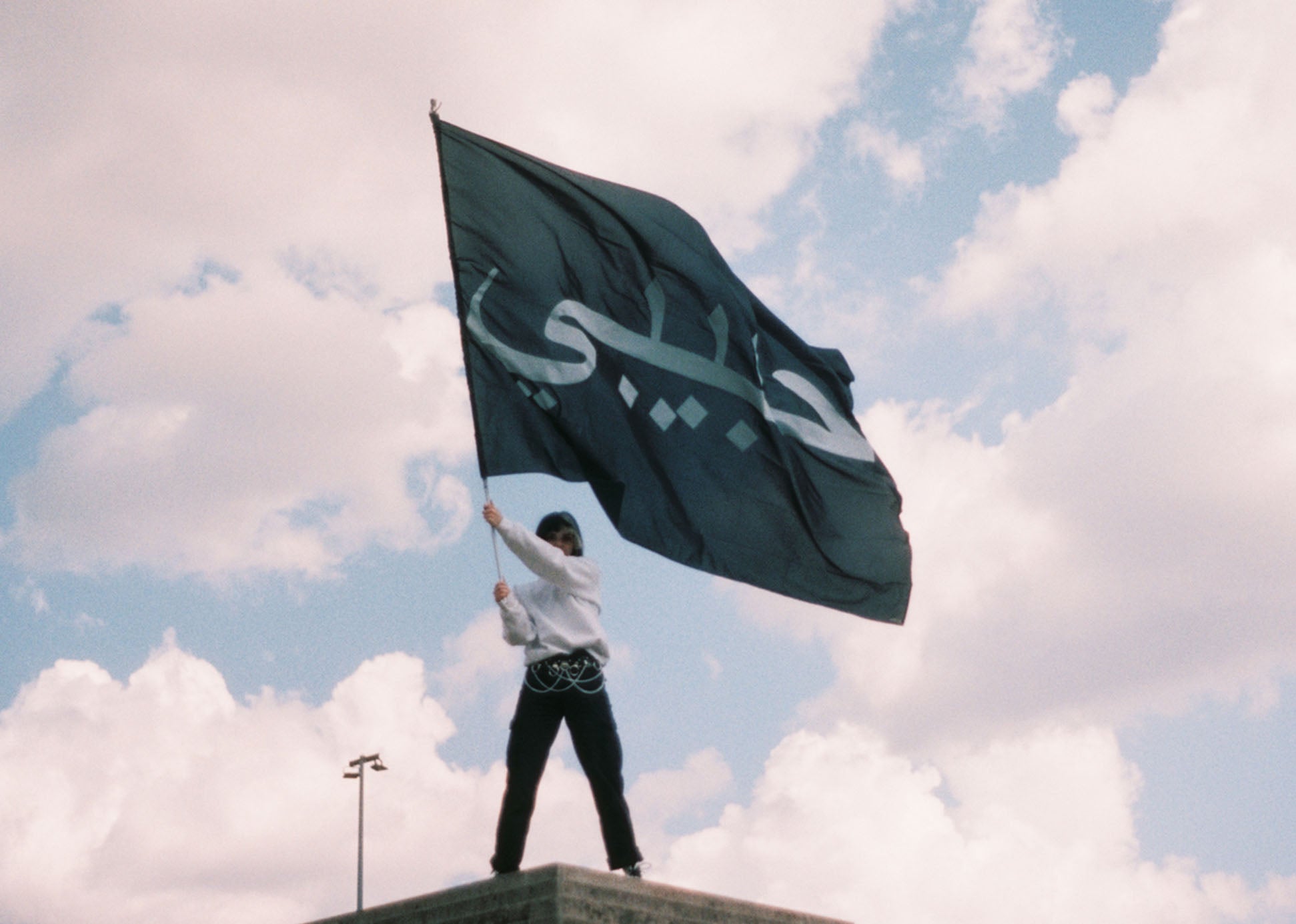
When we collaborated with the Museum für Kunst und Gewerbe Hamburg, it quickly became clear that it wouldn't just be about a single object. We were interested in the question of how Arabic script could be displayed across various levels: in public spaces, in exhibition contexts, in fashion, and in creative staging. This is precisely where the strength of this collaboration lay for us. This was first visible on the facade of the MK&G. There, a large-format banner was displayed, on which "Museum für Kunst und Gewerbe Hamburg, Habibi" was written in Arabic script. The work was created as part of "Inspiration SWANA" and, together with the museum, made a conscious statement for visibility and a positive perception of Arabic script in urban spaces. For us, this banner was not only a creative intervention but also an invitation to read script differently: not as a projection, but as part of public life, culture, and the present. At the same time, our work was not limited to the facade. As part of "Inspiration SWANA," we also had an interactive artistic position in the exhibition. The MK&G describes our work there as a playful approach to the Arabic alphabet — and that was precisely what we aimed for in our own design approach. The exhibition itself marks a new perspective on the museum's SWANA collection and brings historical and contemporary positions into a lively dialogue. For our installation, we worked with lenticular technology and drew inspiration from the logic of a children's ABC book. Through motif, letter, word, and word composition, we wanted to develop a form that creates approachability. Our aim was not to explain Arabic script as something foreign, but to make it so accessible that one could approach it visually, playfully, and intuitively. Especially in a cultural context like this, design interests us most when it not only shows but also creates connections. The collaboration also included a partnership involving two clothing items that carried the project beyond the exhibition space. The products were not intended as mere merchandise, but as an extension of the idea: design that can move, be worn, and reach new contexts. The fact that the items were available in both our online shop and the museum shop continued this connection between brand, institution, and audience in a natural way. The staging was also part of the project. The photo shoot in the museum's Hall of Mirrors gave the collaboration its own visual dimension. In addition, our pop-up during the vernissage of "Inspiration SWANA" allowed the work to enter into immediate exchange with visitors, the space, and the situation. Thus, something emerged around the collaboration that for us was more than a single contribution: an interplay of design, attitude, space, and encounter. For us, this project very clearly shows how we work at Habibi. We understand script not just as a graphic element, but as a carrier of perception, memory, representation, and new legibility. If this results in works that function simultaneously on a facade, in an exhibition, in clothing, and in a campaign, then that is precisely the space that interests us: one where design is not just a surface, but can create cultural closeness.
Learn more
"Fried Potatoes" on 134sqm - Habibi x fritz-kola
Some collaborations are limited to products. This one was bigger for us from the start. With Habibi x fritz-kola, we not only developed a collection of hoodies, t-shirts, and bags, but created a collaboration that went far beyond clothing. For us, this was not a classic product drop, but a project where fashion, design, attitude, and public interaction were intertwined. For us, the core of this collaboration lay not only in the products but in the idea behind them. We have always been interested not only in the formal beauty of Arabic script but also in what happens when it appears in unfamiliar contexts. This is precisely what led to the work at the Hamburger Kunstverein: a 134-square-meter area where "Bratkartoffel" (fried potatoes) could be read in Arabic script—pronounced in German, but translated into a different visual system. This shift was central to us: to envision German terms visibly in Arabic script and thus change perception in public spaces. We transferred this idea into the textile collaboration as well. For the collection, we set "fritz-kola" in Arabic script, working with the same tension on hoodies, t-shirts, and bags that underpinned the entire project: a well-known German brand, read through a different writing system. As a result, the products were not merely carriers of a logo but themselves part of the design statement. Perhaps that was precisely what made this collaboration so special for us. We didn't just want to integrate Arabic script; we wanted to use it in a way that made familiar terms newly legible. Not abstract, not just aesthetically beautiful, but direct, humorous, and right in the middle of everyday life. A word suddenly became more than just language—it became a public moment, a moment of irritation, but also a form of closeness. For us, that's where the power of design lies. The idea was further developed within the campaign, including terms such as "Franzbrötchen" (a type of German pastry) and "Pommes Schranke" (fries with ketchup and mayonnaise). The principle was also continued internationally with adapted terms. For us, it was important that this not only had a strong visual effect but also a clear stance: not to treat Arabic script as an alien element, but as a natural part of the present, humor, urban landscape, and pop culture. The collaboration also included a five-day pop-up, which we conceived and designed as its own space. For this, we developed a kiosk-style space, used refrigerators for product presentation, and created a place where the collaboration could not only be shown but experienced—with DJs, catering, movie nights, and performances. We also conceived and carried out the photoshoot ourselves. The products were designed and produced by us and sold out. Thus, the collaboration resulted not just in a collection, but in a complete project with a clear design signature. The fact that the campaign went viral, a reel with the "Bratkartoffel" motif reached over two million views, and the project was awarded silver at the German Digital Award, further highlighted the impact of this work. For us, however, this was never just a question of reach or awards. What was decisive was that an idea, which arose from our perspective on typography, culture, and design, reached so many people and triggered a genuine reaction. When we look back at Habibi x fritz-kola today, we don't just see a collaboration, but a project that encapsulates much of what Habibi stands for: typography as attitude, design as intervention, humor as an icebreaker, and space as part of the message. For us, it was a moment when an idea became a visible cultural gesture.
Learn more